

New Study Reveals Widespread Clinical Failure in Pre-Abortion Screening
Gulf Breeze, FL (8/28/2026)—The vast majority of women undergoing abortions in the United States possess pre-existing risk factors that clinically contraindicate the procedure, according to a new groundbreaking peer-reviewed study.
Using a topic-blind survey distributed to a national random sample of women, the researchers examined women’s reproductive histories, abortion decision types, pre-abortion risk factors, and negative outcomes women attributed to their abortions. Among respondents, 22.6% reported a history of abortion, a rate that closely matches the Guttmacher Institute’s national estimate.
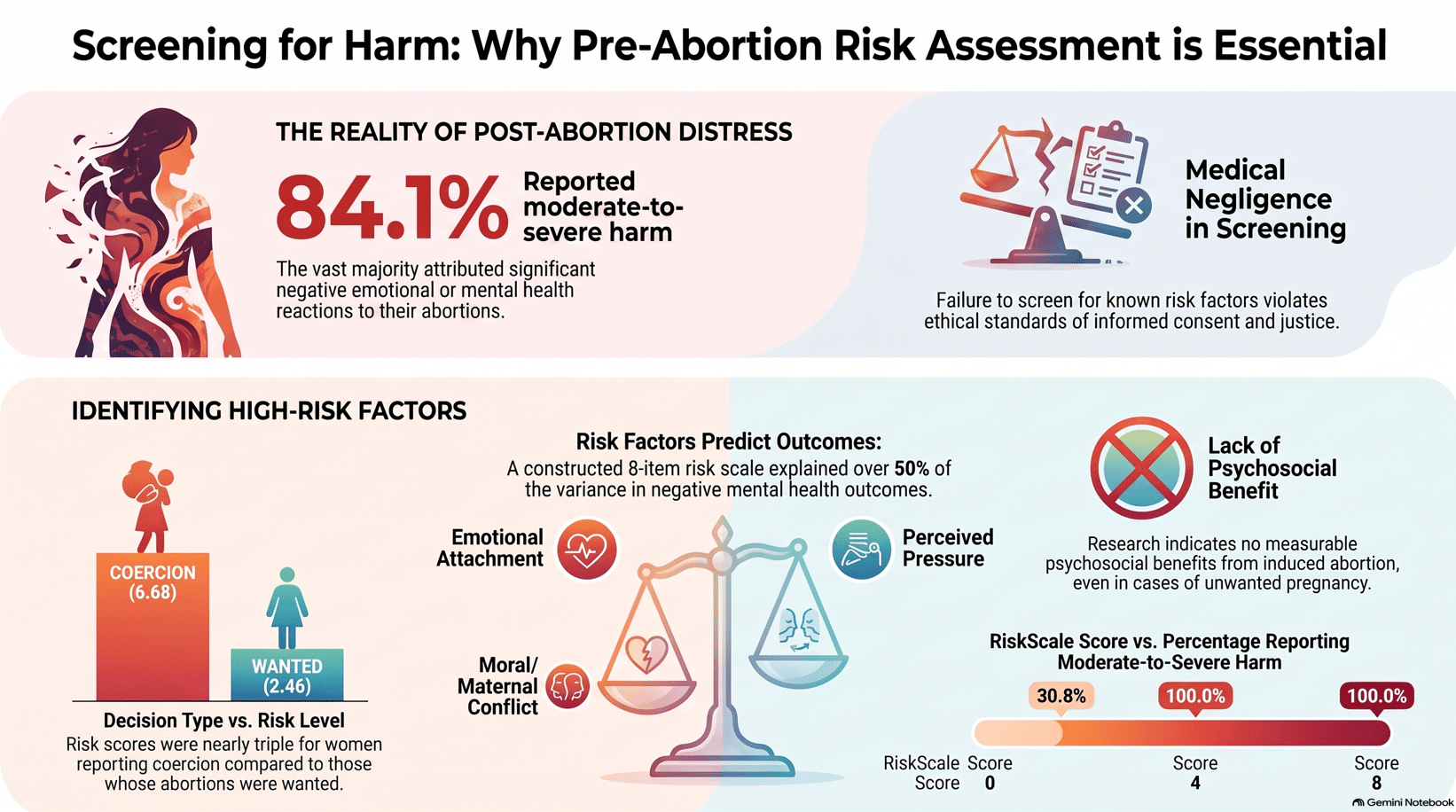
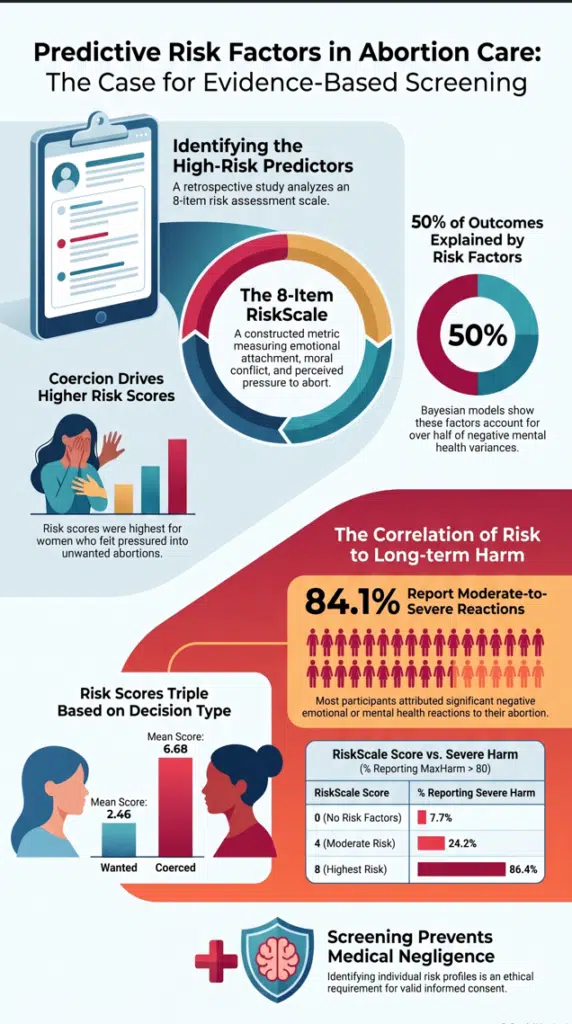
The researchers tested an 8-item risk scale based on known risk factors, including emotional attachment to the pregnancy, conflict with maternal desires or moral beliefs, pressure to abort, lack of support, financial insecurity, and whether the abortion was contrary to the woman’s own preferences.
The study found that women with more pre-abortion risk factors reported greater levels of negative outcomes they attributed to their abortions. Average risk scores on the 8-point scale rose sharply by decision type:
- 2.46 among women who said the abortion was wanted and consistent with their values and preferences
- 4.47 among women who accepted the abortion but said it was inconsistent with their values or preferences
- 5.56 among women who said the abortion was unwanted
- 6.68 among women who said the abortion was coerced
This direct relationship reveals that external pressure are directly correlated with higher risk of severe psychological trauma that, for 20% of women, can last for decades.
Pervasiveness of Harm: 84.1% of the post-abortive women surveyed reported moderate-to-severe negative emotional and mental health reactions (including frequent feelings of loss, grief, sadness, and intrusive flashbacks) which they directly attribute to the procedure.
Predictive Power: Using Bayesian linear regression,
The Conflicted Majority: Two-thirds of women (67%) experienced their abortion decision as a violation of, or inconsistent with, their own values, preferences, or maternal desires.
Only a 33% minority described their abortions as wanted and consistent with their values.
Systemic Coercion: 61% of women reported experiencing high levels of pressure to abort from male partners, family members, or financial/circumstantial concerns. Furthermore, 60% stated they would have preferred to give birth if they had received more support or financial security.
The Legal and Legislative Pathway to Accountability
“Failure to screen for these risk factors is medical negligence,” the authors conclude.
While standard abortion clinic intakes often assess “decision certainty,” they routinely omit systematic screening for pre-existing risk factors predictive of severe emotional distress.
“A woman who is facing pressure and threats from others may say she is certain she needs to have an abortion,” said the lead author, David Reardon, director of the Elliot Institute, “but that is a far cry from saying she truly wants an abortion to satisfy her own needs and desires. Abortion counselors need to ask probing questions, not just obtain consent.”
Abortion counselors who fail to do proper screening may face legal accountability. Under landmark medical malpractice precedents like Canterbury v. Spence and Carr v. Strode, a physician has a strict legal duty to disclose personalized, individual risk profiles that could affect a patient’s treatment decisions.
Furthermore, the study highlights that there are no documented physical or psychosocial benefits directly attributable to induced abortion. Even the pro-abortion authors of the Turnaway Study have conceded that carrying an unwanted pregnancy to term does not cause long-term mental health harm, demonstrating natural maternal resilience.
Recommending an elective procedure with zero proven benefits and high rates of documented harm—without individual risk screening—is a clear breach of the medical standard of care, according to Reardon.
The authors argue that legislation allowing women to sue providers for negligent pre-abortion screening will protect women from predatory, unsafe abortions.
Reference
Risk factors predictive of post-abortion distress demonstrate that most abortions are contraindicated: A retrospective cross-sectional study. Reardon DC, Shuping MW, Giebink PK. Issues in Law and Medicine. 2026 41(1). https://shorturl.at/AwDTi