

The Unwanted Abortion Studies: Coercion, Pressures, Distress, and Suicide Risk
The Unwanted Abortion Studies are an ongoing investigation of the relationship between different pregnancy outcomes (including induced abortion, miscarriage, delivery of an unplanned pregnancy, and delivery of a wanted pregnancy) and associated psychological distress, decision satisfaction, and suicide risk.1–5 Currently, the implemented studies have been based on national random samples of American females aged 41–45. This older age group was chosen to capture the bulk of most women’s reproductive lives and to eliminate, for now, the confounding effects which would appear with a mixed age group.
These studies utilized a retrospective survey methodology, employing sensitive 101-point visual analog scales to measure women’s self-assessments of their experiences. The high response rate regarding abortion history (21.2% to 22.6% reported having had an abortion) suggests a relatively low concealment bias compared to typical national surveys, thereby increasing the reliability of the findings.
The findings collectively reveal strong associations between the nature of the abortion decision (i.e., whether it was wanted or unwanted/coerced) and subsequent mental health and emotional outcomes.
I. Abortion Decision Type and External Pressure
A core finding is that abortion experiences are not monolithic; they vary greatly depending on whether the decision aligns with the woman’s personal values and preferences.
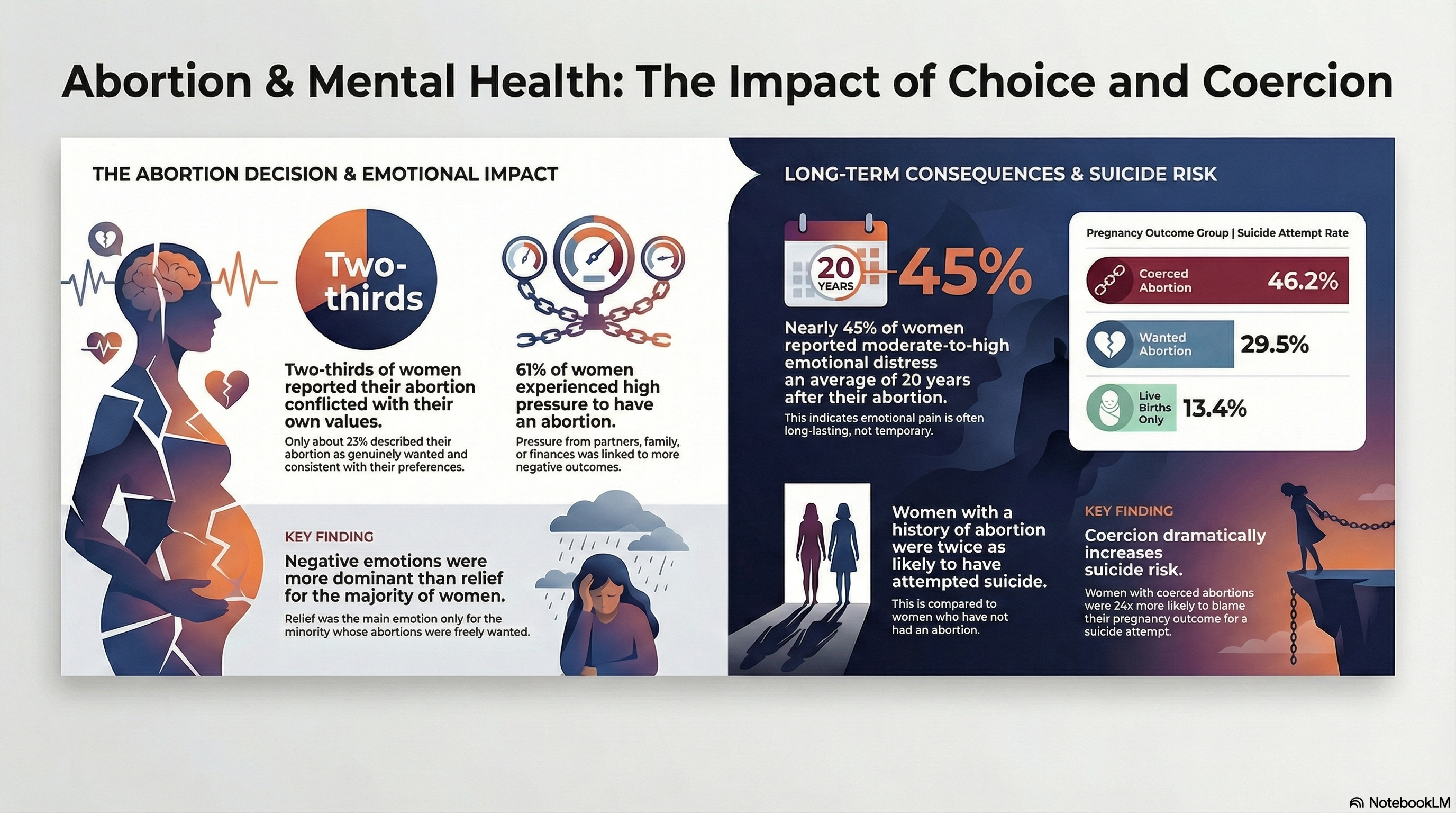
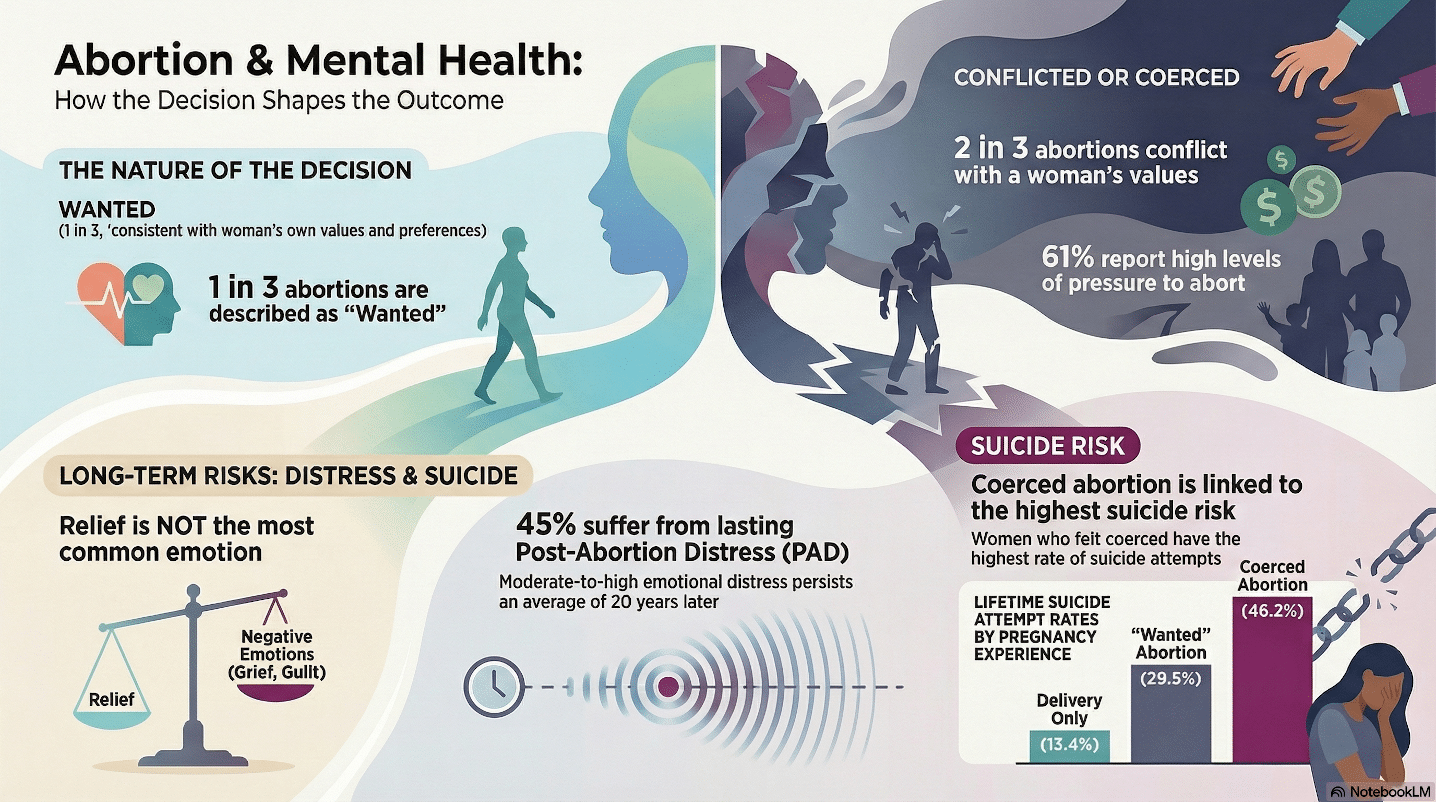
• Prevalence of Unwanted Abortions: Only about one-third (33% or 29.8%) of women described their abortions as wanted and consistent with their values and preferences.
• The Majority Experienced Conflict: Two-thirds of women experienced their abortion decision as a violation of or inconsistent with their own values and preferences. Approximately 24% described their abortions as unwanted or coerced.
• Pressure as a Factor: A majority of women (60%) reported they would have preferred to give birth if they had received more support from others and/or had more financial security.
• High Pressure Levels: Overall, 61% of women with a history of abortion reported experiencing a high level of pressure to abort on at least one scale (e.g., from male partners, family, or financial concerns). Pressure from other people was strongly associated with more negative post-abortion outcomes.
II. Emotional Reactions: Relief vs. Distress
These studies challenge the assertion often cited by abortion proponents that relief is the most common emotion following abortion.
• Relief is Not Universal: Relief was the predominant emotion only among the women whose abortions were freely wanted and consistent with their values (about 30% of the abortion group).
• Negative Emotions Dominate: For all other groups (Inconsistent, Unwanted, or Coerced), negative emotions were reported more intensely and were far more dominant than relief.
• Overall Group Experience: When considering all women with a history of abortion together, emotions such as grief, guilt, shame, depression, and regret were all more prevalent and dominant than relief.
• Self-Judgment and Conflict: Negative emotions related to self-judgment (e.g., guilt, regret, shame, unforgiveness of self) were found to be significantly more intense following Inconsistent or Unwanted abortions compared to those following natural pregnancy losses.
III. Long-Term Emotional Distress and Persistence
A separate analysis of this population suggests that emotional distress often persists for decades following the abortion.
• Persistent Abortion Distress (PAD): Even after an average of 20 years after their abortions, approximately 44.8% of post-abortive women reported moderate (20.7%) to high (24.1%) emotional distress that they attributed to their abortions. PAD persists. It did not significantly diminish over the two decades that were examined. The correlation between PAD and time elapsed since the abortion was statistically insignificant (r = -.02).
• National Estimates: Extrapolating these findings suggests that of the estimated 31 million post-abortive women in the U.S., about 7.5 million suffer high post-abortion distress (PAD), and 3.4 million exhibit multiple symptoms consistent with post-traumatic stress (PTS) related to the abortion.
• Specific Distress Symptoms: High rates of specific distress symptoms were reported, including:
◦ Frequent feelings of loss, grief, or sadness about the abortion (31.2% reported agreement on the high end of the scale).
◦ Frequent thoughts, dreams, or flashbacks to the abortion (24.6% reported agreement on the high end of the scale).
◦ Negative emotions were reported as very high by 38% of post-abortive women.
• Population Estimates: Extending these findings to the national population suggests that, of the estimated 31 million post-abortive women in the U.S., approximately 7.5 million suffer high post-abortion distress (PAD), and 3.4 million show multiple symptoms consistent with post-traumatic stress (PTS) related to the abortion.
• Prolonged Grief Disorder: Overall, 39.1% of the women reported that the worst of their negative feelings continue to persist an average of 20 years after their loss. Most of these women reported symptoms of prolonged grief disorder (PGD) and complicated or disenfranchised grief.
.
IV. Suicide Risk Findings
The study investigating suicide risks found that the association between abortion and elevated suicide risk cannot be entirely dismissed as being due solely to preexisting mental health problems, based on women’s own assessments.
• Attempted Suicide Rate: Women with a history of abortion were twice as likely to have attempted suicide compared to women without such a history.
• Highest Risk Group: The rate of attempted suicide was highest (46.2%) among women who reported feeling coerced into their abortions, significantly exceeding the rate for women whose abortions were wanted (29.5%). Women who had only live births (and no other pregnancy outcomes) had the lowest rate (13.4%).
• Attribution of Cause: Aborting women, especially those whose abortions were coerced or unwanted, were significantly more likely to report that their pregnancy outcome directly contributed to suicidal thoughts and behaviors.
• Coerced Abortion and Suicide Attempts: Compared to women who only had deliveries, women who had abortions were nearly seven times more likely to report their pregnancy outcome as a major contributing factor to their suicide attempts. For women whose abortions were coerced, this likelihood rose to 24 times higher than for women who only had deliveries.

V. Implications for Clinical Practice
The findings underscore the need for improved clinical care and research in this area.
• Screening for Risk: Given the severe risks, pre-abortion screening should identify patients who feel pressured to abort against their own values, and these women should be advised of the elevated risk of suicidal and self-destructive behaviors following the procedure.
• Counseling and Support: Mental health workers and providers should assess perceived pressures and abortion decision types (Wanted, Inconsistent, Unwanted, Coerced) to better identify risks and guide post-abortion counseling.
• Acknowledgment of Distress: Patients struggling with emotional distress should be screened for a history of pregnancy loss, including abortion, and offered an opportunity to explore unresolved grief or guilt that may be contributing to their mental pain
Below the references is an infographic describing Unwanted Abortion Studies
References for The Unwanted Abortion Studies
- Reardon DC, Longbons T. Effects of Pressure to Abort on Women’s Emotional Responses and Mental Health. Cureus. 2023;15(1):e34456. doi:10.7759/cureus.34456
- Reardon DC, Rafferty KA, Longbons T. The Effects of Abortion Decision Rightness and Decision Type on Women’s Satisfaction and Mental Health. Cureus. 2023;15(5). doi:10.7759/CUREUS.38882
- Reardon D. Is relief the most common reaction to abortion? Self-assessed intensity of emotions attributed to abortion in a national sample of women aged 41 to 45. F1000Res. 2025;14. doi:10.12688/F1000RESEARCH.162063.2/DOI
- Reardon DC. Suicide risks associated with pregnancy outcomes: a national cross-sectional survey of American females 41–45 years of age. Journal of Psychosomatic Obstetrics and Gynecology. 2025;46(1):2455086. doi:10.1080/0167482X.2025.2455086,
- Sullins P. Persistent Emotional Distress after Abortion in the United States International Journal of Women’s Health Care. 2025;10(3):1-13.
- Reardon, D. C. (2025). Degrees of grief and complicated grief self-attributed to natural and induced pregnancy losses in a national population of 41–45-year-old females. Journal of Psychosomatic Obstetrics & Gynecology, 46(1). https://doi.org/10.1080/0167482X.2025.2503286

Thanks for all this David… we want to use some of this in our documentary TRUTH Matters: The impact of abortion… What are the dates of those studies above…on pressure, coercion and suicides…i could not seem to get the larger version of the infograph on mental health above??
God bless you!
Denise
I believe the link has been fixed. Thanks for pointing out the break.
The dates, and complete titles and links, to the studies are all listed at the bottom of the page.